
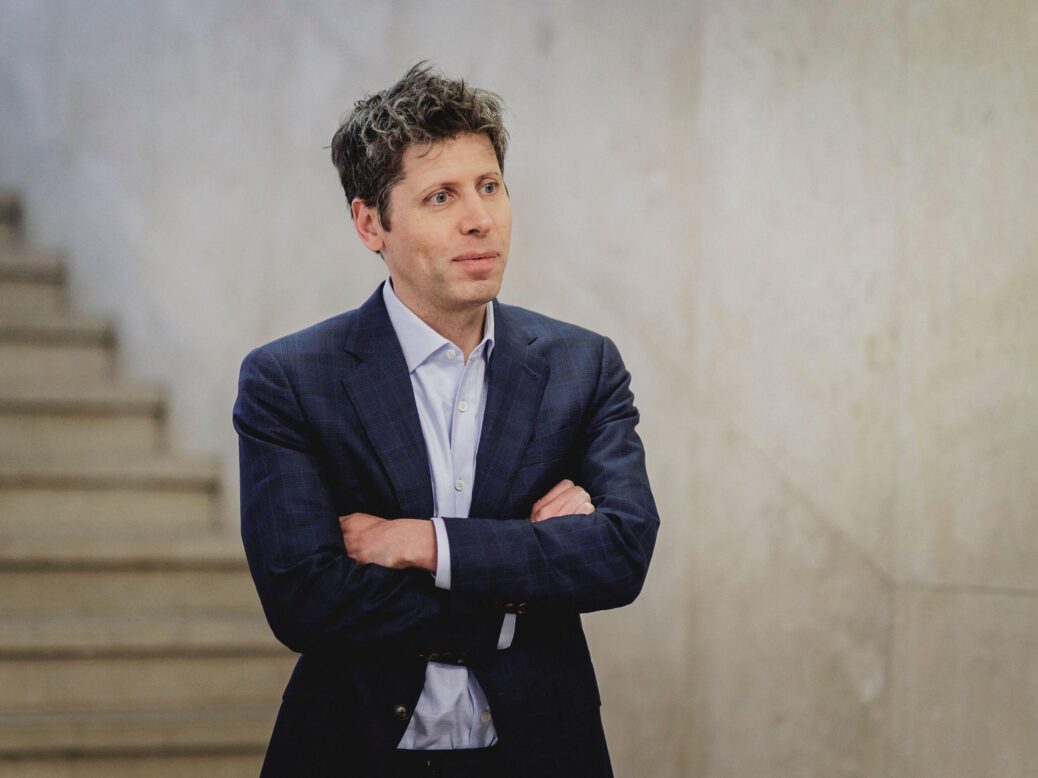
On Friday, a molotov cocktail was thrown at the San Francisco home of OpenAI CEO Sam Altman. The culprit has not yet been identified. But internet sleuths have linked the attack with “Butlerian Jihad”, an anti-AI movement that takes its name from the injunction in Frank Herbert’s Dune series to destroy all “thinking machines”.
It capped off a disquieting week for Altman, still reeling from the New Yorker’s marmalade-dropper of a piece on him by Ronan Farrow and Andrew Marantz. The piece, headlined “Sam Altman May Control Our Future – Can He Be Trusted?” is the sort of exhaustive investigation that the New Yorker does so well. It weighs in at over 16,000 words, and its authors interviewed over a hundred acquaintances, friends, classmates and colleagues – including, it must be acknowledged, many of his sworn and bitter rivals in the field of artificial intelligence. They found that a staggering number of them are willing to go on record calling him a fantasist, dissembler and, several times, a sociopath.
In fact, the portrait it paints is of a man incapable of telling the truth, or even of telling the same lie consistently for a sustained period of time; a man whose constant predictions, exaggerations, misrepresentations and outright fabrications have left dozens of his peers wondering if he’s “merely” a bullshit artist who’s spent the past five years peddling whatever lie is necessary to get him to the next billion dollars or – worse still – a man capable of convincing himself of his own bullshit each time.
The piece is not, to put it mildly, a flattering portrayal of one of the planet’s most powerful men, one who is still fawned over by much of the world’s press. But nor does it really get to the heart of the baseline claims he’s made his life’s work as a media character. If you have any awareness of Altman at all, it’s likely as a result of his wearyingly consistent appearances on our newsfeeds, usually in the form of an eye-popping headline quote from him, relating some lavish prediction or dire warning about AI.

Unlike Musk, Bezos or Zuckerberg, Altman was not a fixture in the crossover sphere of famous tech billionaires until quite recently. His sudden appearance at the top of the world’s roll call of fleece-wearing founders came around the end of 2022. To outsiders, it may have seemed like he’d parachuted in from nowhere, in the manner of a new cousin suddenly present in the ninth series of a flailing family sitcom, one whom you are bidden to pretend has been there all along. This was due to his company OpenAI’s launch of ChatGPT, the large language model released in November of that year, which had barely uttered its first chirpy, bullet-pointed answer to a recipe query before its name had become shorthand for the entire profusion of LLMs which followed.
Soon, Altman was everywhere, prognosticating on all the ways AI could, would and should, transform, improve and/or destroy the world. He has, at different times, claimed AI would achieve superhuman intelligence by 2025, wipe out jobs that aren’t “real work”, turn intelligence into a utility that OpenAI sells to an increasingly stupid populace, and/or destroy humanity entirely. He has also expressed concerns that the entire AI market could be in “a bubble”. On that, at least, we agree.
I hate all of this because it’s asinine, and also because it reveals our tech overlords have contrived a media environment where they can say literally anything and not just have it treated not just as fact, but news. Altman is not alone in this, of course. Altman’s main competitor – and original co-investor, Elon Musk – has spent years spouting spurious bollocks, predicting humans on Mars by 2024 (in 2016), 2026 (in 2020) 2029 (in 2022), 2030 (this year). Just this month, OpenAI’s main rival Anthropic claimed their AI client Claude feels emotions.
In case it’s not already clear, I don’t care very much that these people have deluded themselves into thinking the lovely wooden doll they’ve made is a real, live human boy. What’s more relevant is what they do with that delusion, and the degree to which said delusions are taken seriously as claims, let alone as breathlessly reported fact, by the media we task with explaining the complex world of technology to us. A media that has responded to these people’s addiction to headlines by becoming similarly addicted to printing them. Like many a teenaged radical, I used to moodily resent the unseen world of business barons who kept in the dark and managed our lives from the shadows. Now, I want to thank them for their service: for sparing us the sight of their faces in our news feeds every hour of every day. Say what you want about the Koch Brothers and their media influence, but they weren’t doing speaking tours about the Antichrist, or keeping us up to date on the frequency and strength of their night-time erections.
There are still those of us who do not believe Altman’s $1trn word-guessing programme is going to save, rule, or destroy, the planet any time soon. We boggle that so much uncritical coverage is given to a company that is very far away from making a product that works usefully as a search engine or a calculator, let alone an all-knowing superintelligence that will remake the modern world. It is a technology so riddled with errors and hallucinations that ChatGPT is now a byword for unchecked work that is hastily and lazily cobbled together by scammers and morons. This company has already leveraged the greatest capital expenditure and computing power ever assembled in one place to deliver a technology which cannot reliably tell you how many “R”s there are in the word strawberry, or refrain from telling you to clean your home with chlorine gas.
It is also a company whose finances are so worryingly opaque that it is very hard to know where the truly gigantic and ongoing investment will come from in order to let it keep losing money ad infinitum. (At this point, failure to do so would also likely crash the global economy.) This was all to make a product so programmed to peddle convincing nonsense that ChatGPT’s leading contribution to mankind thus far has been the harrowing catalogue of tragedies in which it has been directly or indirectly involved. These range from spiritual delusions and psychotic breaks to real-life murders, suicides and at least two mass shootings.
If the reports about Altman’s heinous attacker are true, and the culprit really is someone radicalised into believing OpenAI’s products are as powerful as Altman has claimed, then we might ask what good this collective delusion does any of us. Approaching his bluster more critically would be a good start on the road to unweaving the breathless AI hype that has led us to each of these nesting absurdities. The question is not whether we should trust Sam Altman to wield a power this great – it’s why on Earth are we trusting him at all?
[Further reading: How AI captured Westminster]
Content from our partners


Related
Join the debate
Subscribe here to comment